Running out of replacement poles during an active storm recovery is not a rare edge case reserved for small or underprepared utilities. It has happened to well-resourced operations during significant weather events, and it has happened in ways that extended customer outages by multiple days beyond what the damage itself required. The conditions that produce it – inadequate pre-positioned inventory, poor yard infrastructure, optimistic supply chain assumptions, and staging locations too far from the damage zone – are present in a significant share of utility operations across the country.
The cost of an inventory failure during recovery is not just the cost of locating additional poles. It is every hour that passes between when the repair crew is staged and ready to work and when the next pole arrives. That cost compounds across every crew standing by, every customer still without power, and every hour that shows up in a regulator’s restoration timeline analysis.
How Inventory Failures Actually Happen
The pattern is consistent across events. A major storm damages a larger number of poles than the utility’s pre-storm inventory was sized to replace. Field crews move through available inventory faster than initial damage assessment suggested because the actual extent of damage exceeds the estimate – a routine characteristic of major storm events, not an anomaly. The utility places emergency orders with suppliers, but lead times and competition from other affected utilities in the same region mean that additional poles arrive in days, not hours. In that interval, restoration stalls.
The geographic dimension compounds the problem. A central yard with adequate inventory that is 90 miles from the damage zone is a different operational asset than one 20 miles away. As crews work through the inventory at the main yard, each resupply run from yard to staging site consumes hours. Road conditions in a major storm aftermath are rarely normal. Routes that are 90 minutes in ideal conditions may be three hours through debris, flooded intersections, and emergency vehicle traffic. The effective resupply rate from a distant yard under those conditions is a fraction of what the nominal distance suggests.
The Regulatory Dimension
State public utility commissions track restoration timelines with a level of specificity that most utility operations managers are aware of but few have examined closely in the context of their own infrastructure. Major outage events trigger formal reporting requirements under most state commission rules. Those reports capture the timeline from outage onset to restoration for affected customers, the resources deployed, and the factors that influenced the timeline.
When a restoration extends significantly beyond the commission’s performance benchmarks – derived from historical performance and peer utility comparisons — the commission may initiate a review. That review will ask whether the utility’s preparation was adequate given the known risk profile of its service territory. A utility operating in a hurricane-prone coastal region that ran out of poles because it had not pre-positioned inventory for the scale of storm damage its region is known to produce is in a structurally weaker position in that review than one that can demonstrate systematic preparation.
In some jurisdictions, extended outages attributable to inadequate preparation carry financial exposure beyond the regulatory review. Customer compensation requirements, rate case implications, and performance-based regulation mechanisms can translate a multi-day restoration delay into a quantifiable financial consequence separate from any direct cost of the event itself.
What the Reputational Exposure Looks Like
Real-time outage maps, social media, and 24-hour local news coverage have fundamentally changed the public visibility of utility restoration performance. A community without power for five days following a storm that neighboring utilities restored in 48 hours will ask why, and the question will be asked publicly, repeatedly, and with the comparison data readily available to anyone with a smartphone.
Customer trust in a utility is built over years and eroded quickly. A restoration performance failure attributable to inadequate preparation — and that can be characterized that way accurately – produces a reputational consequence that regulatory relations and community communication programs struggle to offset. The utilities that restore quickly are not necessarily the ones with the largest crews. They are the ones with the right inventory, in the right location, on the right infrastructure, ready to move the moment assessment is complete.
What Adequate Preparation Actually Requires
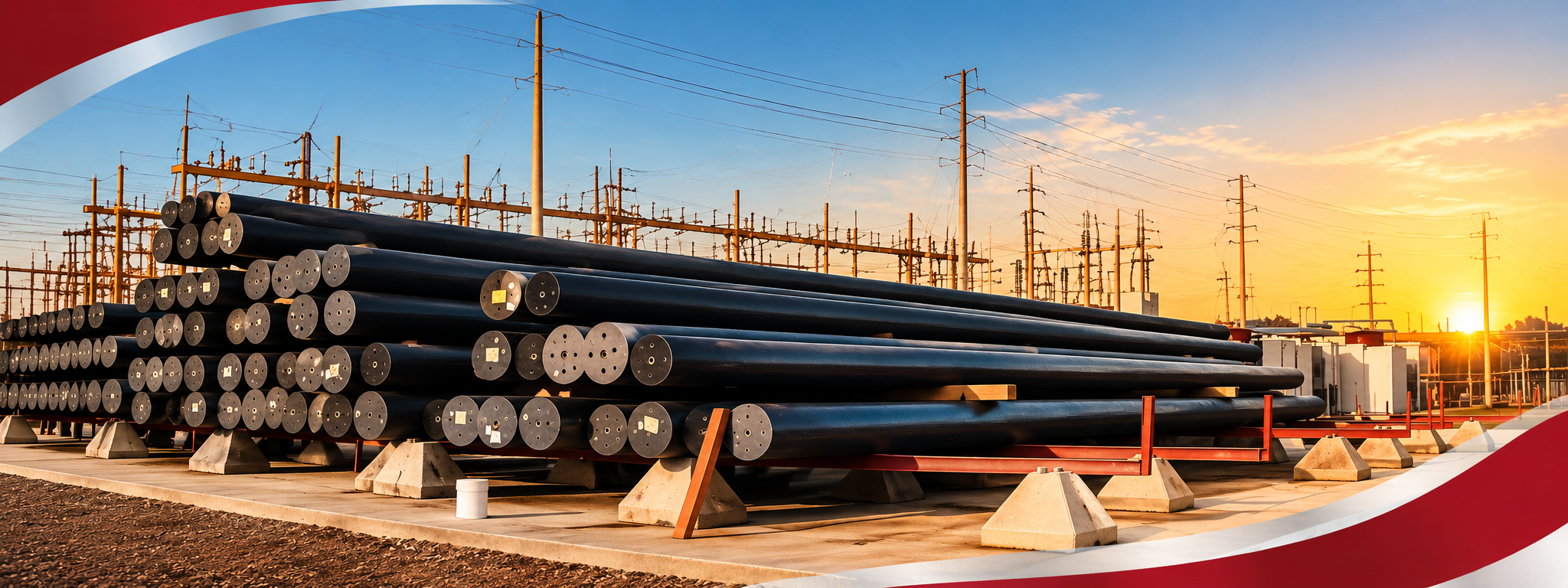
The utilities that handle major storm recovery without running out of poles share a set of common characteristics. They carry inventory sized for realistic storm scenarios in their service territory, not just base operating requirements. That inventory is stored in facilities that preserve its condition and allow rapid dispatch — on engineered rack systems, off the ground, accessible for loading without delay. They have pre-positioned capacity at regional locations that reduce the distance between stored inventory and the damage zone. And they have pre-negotiated surge agreements with vendors who can provide additional rack systems and deployment support within 24 to 48 hours of a request.
CMS pole rack systems are delivered pre-configured and ready to use. No on-site assembly. No wait time before the first pole loads. Utility crews position the rack and begin loading immediately. CMS can also handle transport and on-site positioning directly for utilities that prefer a fully managed deployment.
The pole inventory failure scenario is preventable. The prevention requires planning that happens before storm season, preparation that is in place before the storm arrives, and infrastructure that functions the moment it is needed. The utilities that have experienced an inventory failure during recovery already understand the cost. Those that have not are carrying the same underlying risk whether or not they have quantified it yet.
Talk to CMS About Emergency Rack Deployment and Storm Preparedness
CMS Utility Services provides pre-configured pole rack systems, free pole yard design, and nationwide emergency deployment support for utility companies across the United States and Canada. If you want to review your current storm preparedness posture – inventory positioning, rack capacity, or staging logistics – our team can walk through your specific situation and identify where the gaps are.
☎ Call us: Kentucky: (502) 362-9797 | Florida: (941) 743-7889 → Visit: Emergency Pole Rack Deployment – cmsus.com/emergency-pole-rack-deployment/