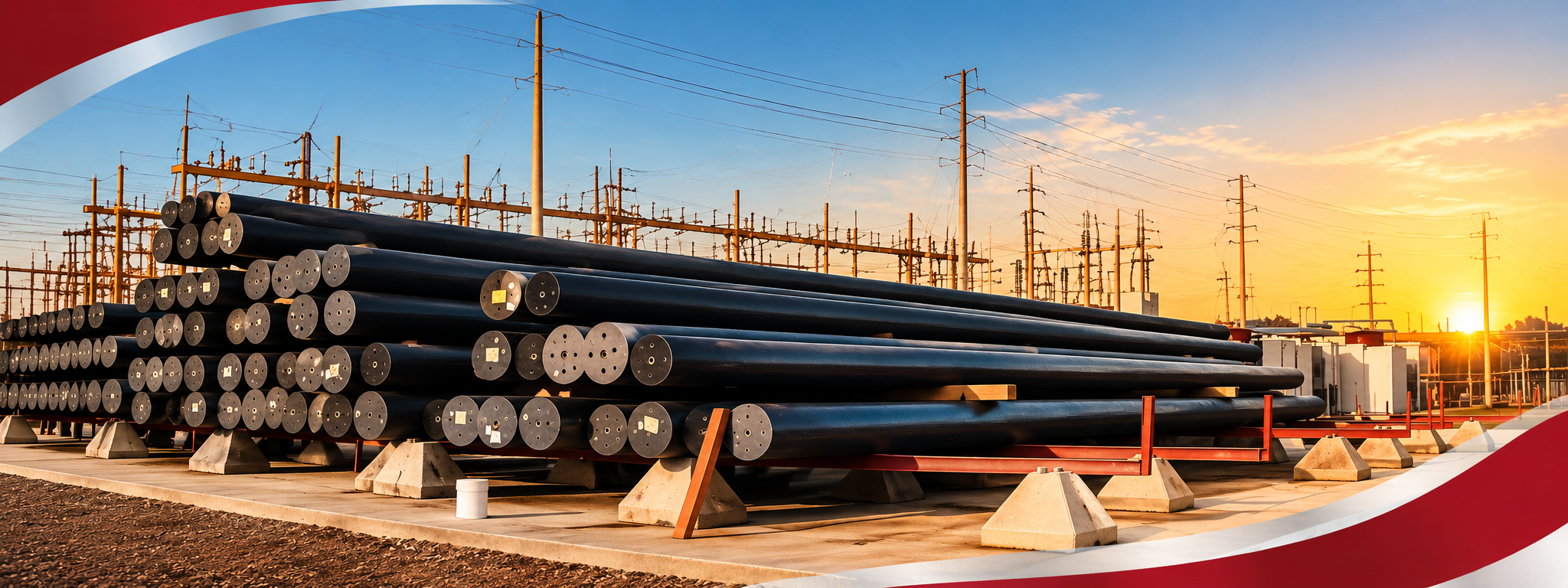
Fiberglass utility poles are still a minority in most North American yards, but that share is growing. Utilities in coastal zones, wildfire-prone regions, and areas where long service life matters are moving away from preservative-treated wood, and composite poles are following.
What if the racks that have served your yard for years are the reason your fiberglass inventory keeps showing up damaged?
What most yards discover after the first shipment arrives is that storage systems built for wood, steel, or concrete do not manage fiberglass the same way. Getting it right from day one is far cheaper than correcting the damage later.
1Fiberglass Utility Pole Storage Requirements
Fiberglass utility poles should be:
- Stored above ground on properly designed pole racks
- Supported at intervals specified by the manufacturer
- Rested on full-width bearing surfaces at every contact point
- Separated with spacers to allow air circulation around all surfaces
- Stored clear of fuels, solvents, and any chemical areas in the yard
- Shaded or covered when the poles are sitting outside long-term
- Checked regularly for bowing, surface damage, and support point wear
Unlike treated wood poles, fiberglass carries no chemical preservatives, so the runoff management infrastructure that shapes most wood pole yards does not apply here. What fiberglass is sensitive to instead is poor support and handling, which causes bowing, stress concentrations, and surface damage that wood or steel poles would shrug off.
2Why Fiberglass Poles Behave Differently in Storage
Fiberglass utility poles are hollow composite structures, typically made through a process called pultrusion or filament winding. They weigh roughly 20 percent of steel poles and about 40 percent of their treated wood counterparts. That lighter weight is a genuine field advantage. In storage, though, it creates a different kind of vulnerability.
Since fiberglass poles are hollow, they are more susceptible to deflection under their own weight when support is inadequate or unevenly spaced. A wood pole resting on two contact points might show no change after weeks on the ground. A fiberglass pole stored the same way will bow, and that bow does not always spring back. A pole that has taken a permanent set in storage comes off the yard already compromised before it ever reaches a job site.
The other difference is chemical. Wood poles carry creosote, pentachlorophenol, or copper naphthenate into the yard. Fiberglass carries none of that. It is immune to the rot, insect damage, and fungal decay that make chemical treatment necessary for wood. Fiberglass storage is cleaner in that respect, but it is not simpler.
3How Fiberglass Storage Differs From Other Pole Materials
| Storage Factor | Wood Poles | Steel Poles | Fiberglass Poles |
|---|---|---|---|
| Ground Contact Sensitivity | Moderate | Low | High |
| Deflection Risk | Moderate | Low | High |
| Need for Chemical Containment | High | Low | Low |
| UV Exposure Concerns | Low | Low | Moderate |
| Air Circulation Importance | Moderate | Low | High |
| Point Load Sensitivity | Moderate | Low | High |
The practical takeaway is that fiberglass combines the handling sensitivity of a lightweight material with the long-term performance expectations of a utility asset, making proper storage more critical than many yards initially expect.
4Elevation and Air Circulation Are Not Optional
Published composite pole specifications are explicit on this point. Fiberglass poles stored outdoors must be raised above ground level and separated with spacers that allow free air circulation to all surfaces.
Ground contact concentrates moisture against one face of the pole while the opposite face stays exposed. Over a long storage period, that imbalance creates surface degradation conditions that would not affect a solid wood or concrete pole the same way. Elevation eliminates the contact point. Ventilation between poles manages the moisture environment across all surfaces.
This is where utility pole rack installation is not a secondary step. It is where the fiberglass utility pole storage guidelines begin. A rack that keeps composite poles off the ground, supports them across the full width of every contact point, and lets air circulate between them is the least any fiberglass storage setup should do. Composite pole designs also vary by manufacturer, length, and wall thickness, so support spacing and storage configurations can differ between products. The manufacturer’s documentation is the starting point, not a fallback.
5Support Spacing and Point Load Management
Composite pole storage standards call for blocking and spacers that span the full width of each bearing point, positioned so that no undue stresses are imposed on the poles. That requirement exists because fiberglass poles do not distribute load the way concrete or solid steel poles do. A hard, narrow contact point on a hollow composite structure concentrates stress locally. Multiply that across a long storage period, and the result is a pole that arrives at the job site with stress marks, localized deformation, or internal damage that is difficult to see until it is already in the field.
Are your racks distributing load across the pole, or quietly concentrating it at a handful of pressure points?
The right pole racks for fiberglass use full-width bearing surfaces at each support point, not rounded steel cradles or narrow cross members built for heavier, solid pole materials. The support interval also matters. Spans that cause no problem for a steel pole can produce visible sagging in a fiberglass one, particularly in longer lengths. Configuring rack systems to match the span requirements of the composite poles in your yard is not a refinement. It is a basic handling requirement.
6Common Fiberglass Utility Pole Storage Mistakes
- Storing poles directly on the ground. Poles on the ground pick up uneven loading and are far more likely to bow permanently than poles that were never in contact with it.
- Using narrow bearing surfaces. Steel cradles and narrow cross members act like pressure points on a hollow pole instead of distributing the load. That stress accumulates quietly and shows up at the job site.
- Ignoring manufacturer support spacing requirements. What works for wood or steel often leaves too much unsupported span for fiberglass. The pole manufacturer’s spec is the reference point, not the existing rack setup.
- Mixing fiberglass inventory with chemical storage areas. One spill or splash from nearby fuel or solvent storage can damage the resin surface. Separation between fiberglass inventory and chemical storage is not precautionary. It is required.
- Long-term outdoor storage without UV considerations. Fiberglass is built for the outdoors, but the resin surface weathers faster under prolonged direct sun in storage conditions than manufacturers design for in active service. Shading during extended outdoor storage is worth the effort.
7How Yard Layout Affects Storage Outcomes
Rack configuration is only part of the picture. Fiberglass poles need to be stored away from solvents, fuels, and chemical storage areas, regardless of how well the racks themselves are set up. While the poles carry no chemical preservatives, certain industrial chemicals attack composite resin surfaces on contact. A yard where fiberglass poles sit adjacent to fuel tanks or chemical treatment areas carries a risk profile that the racks cannot solve.
Thoughtful pole yard design & construction accounts for these segregation needs from the beginning. Fiberglass pole storage gets its own defined zone, with access lanes sized for equipment handling lighter composite poles rather than the heavy-lifting gear built for concrete inventory. Routing delivery trucks and forklifts through fiberglass storage without a clear lane plan creates incidental contact damage that no rack system can prevent. Most composite poles also have UV-resistant coatings, but manufacturers still recommend limiting direct sun exposure during extended storage because surface weathering in a yard is different from weathering in active service.
8What to Do Before the First Fiberglass Pole Arrives
Yards that have not managed composite poles before tend to walk in assuming what worked for wood or steel will carry over. It does not. The gear, the management techniques, and the rack configurations that crews have used for years are each wrong for fiberglass in different ways. Getting ahead of that before the first delivery is cheaper than correcting storage damage after it has set in.
That means auditing existing rack infrastructure for bearing surface compatibility, checking the yard layout for chemical segregation and UV exposure risks, and confirming that support spacing matches the span requirements of the specific composite pole lengths being ordered. Reviewing the manufacturer’s storage and handling documentation before the first shipment arrives is not optional. Support requirements can vary significantly between products and pole lengths.
9What to Inspect In Fiberglass Pole Storage
Storage inspections should cover:
- Visible bowing or sagging along the pole length
- Surface cracking or resin damage
- Deformation at support points
- Damaged spacers or blocking materials
- Signs of chemical exposure
- Impact damage from forklifts or equipment handling
The longer the storage period, or the more times poles change location before installation, the more important a consistent inspection rhythm becomes.
The Bottom Line
Fiberglass utility poles remain durable in service, but that durability depends on how they were managed before they went in the ground. Elevation, support spacing, air circulation, chemical separation, UV management, and regular inspections all keep a fiberglass pole performing the way it should from the day it arrives to the day it gets installed.
CMS Utility Services has spent over four decades helping utility yards work through exactly this kind of material-specific challenge. Whether that means configuring pole racks for composite inventory, customizing pole yard design and construction for the specific demands of fiberglass handling, or planning a pole rack installation that meets composite pole specifications from the outset, the team knows what the work requires in a yard.
Frequently Asked Questions
Can fiberglass utility poles be stored on the same racks as wood or steel poles?
Not without modification in most cases. Standard racks built for heavier, solid poles tend to have narrower bearing surfaces and wider support intervals than composite poles need. Fiberglass requires full-width contact at every support point and tighter spacing along the span. Running composite poles through a rack system built for something else risks bowing and surface damage that often does not appear until the pole is already on the job site.
Do fiberglass utility poles require environmental containment systems?
No. Fiberglass poles carry no chemical preservatives, so there is no runoff management concern of the kind that creosote or pentachlorophenol-treated wood creates. Your facility still carries its own site-specific stormwater obligations, so confirm what applies to your yard independently of the pole material.
What actually causes a fiberglass pole to bow during storage?
Usually one of three things: support spacing that is too wide for the pole length, bearing surfaces that are too narrow and concentrate load at a single point, or an unsupported span left that way long enough for the material to take a permanent set. Unlike solid poles, fiberglass is hollow, which gives it less built-in resistance to gradual deflection when the storage setup is not configured with composite material in mind.
How often should fiberglass utility poles be inspected while in storage?
After any significant weather event, any equipment contact near the storage area, and any time inventory moves in meaningful volume. Outside those triggers, a regular inspection rhythm keeps you ahead of bowing, surface damage, and support point wear before they compound into something harder to address.
When should a utility yard upgrade its pole rack system for fiberglass poles?
Before composite inventory arrives, not after. Upgrades are also worth evaluating when fiberglass usage is expanding, when recurring storage-related damage is showing up on inspections, or when existing racks cannot meet the manufacturer-recommended support spacing for the pole lengths being stored.
Ready to get your yard set up right for fiberglass inventory?