The design assumptions behind most utility pole yards were established decades ago. Yard size, storage capacity, and location were determined by historical storm frequency, the supply chain conditions of the time, and an operational model built around a central facility serving a defined service territory. Those assumptions are no longer accurate in a large and growing number of service territories across the United States and Canada.
What has changed is not just that severe weather events are more frequent or more damaging in regions that have always faced them. The geographic reach of infrastructure-threatening events is expanding into territories without recent historical precedent. Wildfire is reshaping utility operations across the West in ways the industry is still adapting to. And the efficiency expectations of modern utility operations – faster deployment, tighter inventory management, less wasted crew time – are placing new demands on yard infrastructure that was never designed to meet them. Utilities that have managed major events in the past five years are asking fundamentally different questions about their infrastructure than the ones that shaped the yards they currently operate.
The Changing Storm and Wild Fire Geography
Hurricane tracks that historically concentrated along the Gulf Coast have extended further inland and further up the Eastern Seaboard in major events. Ice storm events are occurring with damaging frequency in regions without historical exposure to that type of infrastructure stress. Derecho events across the Midwest and Plains have produced damage footprints that resemble hurricane aftermath more than the localized severe thunderstorm damage those regions were designed around.
Wild fires in the western United States have introduced a distinct category of infrastructure demand that does not follow the seasonal patterns or geographic logic of traditional storm response. Public Safety Power Shutoffs – planned de-energizations that utilities conduct to reduce ignition risk during high fire-danger conditions – have created cycles of planned outage, rebuilding activity, and staged pole deployment that operate alongside, and sometimes independently of, traditional emergency response. Utilities in fire-prone service territories across California, Oregon, Washington, and the Mountain West are cycling higher pole volumes through storage infrastructure over longer windows, often in remote terrain with limited road access, high seasonal fire risk, and significant logistical complexity. The infrastructure demands of wildfire operations require pre-positioned, portable storage capacity that can be moved ahead of advancing fire risk rather than deployed after the fact.
The operational consequence of both storm and wildfire geography is the same: a central yard sized for historical events and located based on historical risk distribution is inadequate for the conditions utilities are actually responding to now. The damage footprint, the distance from inventory to repair site, and the unpredictability of when and where infrastructure demand will spike have all changed faster than most yard infrastructure planning has kept up with.
What Distributed Yard Infrastructure Looks Like
The infrastructure response that high-performing utility companies are moving toward is distribution of storage capacity across the service territory rather than concentration at a single central facility. That does not require every service location to carry a full pole inventory. It requires strategic positioning of rack capacity and standing inventory at locations selected based on storm vulnerability mapping, wildfire risk assessment, road network access during damage scenarios, and proximity to the service areas most exposed to infrastructure events.
A regional staging yard with 500 poles and a properly designed rack system positioned 20 miles from a historically storm-vulnerable or fire-exposed service area is a different operational asset than a central yard with 5,000 poles located 90 miles away. When the road between the central yard and the damage zone is blocked by debris, flooding, or active fire activity – a routine scenario in major event recovery – the regional asset is the operational lifeline.
The design of those regional facilities requires the same attention to site conditions, drainage, EPA containment requirements, and rack configuration as a primary yard. The scale is different; the standards are not. CMS Utility Services has designed distributed yard systems for utilities that have made this transition, working through site selection, layout, and infrastructure requirements for each regional location in the context of the overall service territory. That design work is provided at no cost to utility clients.
The Efficiency Dimension
Storm resilience and wildfire preparedness are the headline reasons utilities are redesigning their yard infrastructure. Operational efficiency is an equally significant driver – and one that delivers measurable return on every working day, not just during emergencies.
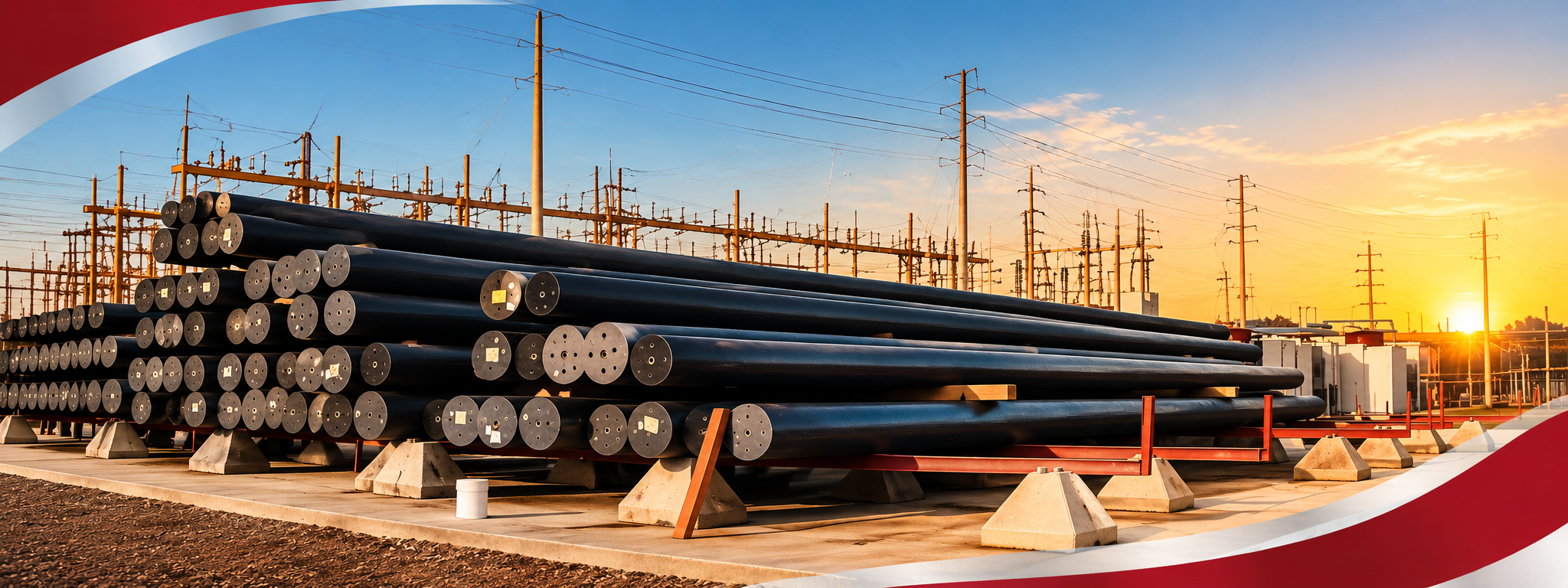
A pole yard designed around modern operational requirements moves inventory faster, with less crew time and fewer handling steps, than one built around outdated ground-storage assumptions. Poles on a properly engineered rack system are accessible without unstacking, load cleanly onto transport vehicles without repositioning, and can be inventoried accurately without a full physical count. Crews spend their time on line work, not yard logistics. That efficiency compounds across every working week and becomes critical during high-volume recovery operations when speed and accuracy both matter simultaneously.
Yard layout affects efficiency as directly as rack configuration. Access lane width for truck and crane maneuvering, inventory segmentation by pole class and length, loading zone positioning relative to the entry gate, and drainage design that keeps the yard operational during and after precipitation – these are not incidental design details. They determine how long it takes a crew to pull a load and get moving, and that time accumulates across thousands of loads over the life of the yard.
CMS designs yards with operational workflow built in from the start. The layout is developed around how the yard actually gets used – which vehicles enter, how often, from which direction, at what volume, under what conditions. A yard that flows well in daily operations also performs well under the stress of emergency response, because the efficiency the design builds in does not disappear when the pressure increases.
Emergency Deployment as a Bridge to Permanent Capacity
Utilities not yet through the capital planning process for permanent distributed infrastructure have an immediate option. Pre-configured emergency pole rack systems from CMS can be pre-positioned at regional locations before storm season and deployed to staging sites within hours of damage assessment or wildfire activation. They require no on-site assembly. They arrive complete, get positioned at the staging location, and are immediately ready to receive inventory.
For a utility that has identified a regional coverage gap but has not yet built the permanent facility to close it, pre-positioned emergency rack capacity provides real operational coverage in the interim. It is not a substitute for permanent infrastructure over the long term. It is the bridge that keeps operations functional while the permanent solution is being built – and a contingency that remains valuable even after permanent capacity is in place, for the events that exceed it.
What Regulators Are Looking for After Major Events
State public utility commissions reviewing post-storm and post-wildfire restoration performance are increasingly focused on preparation, not just outcomes. A utility that takes four days to restore power after a major event will be asked what it had in place to enable that timeline. A central yard 80 miles from the damage zone with no pre-positioned inventory is a weaker answer than a distributed storage strategy with documented staging capacity close to the impact area.
In wildfire-affected jurisdictions, the regulatory scrutiny is particularly pointed. Public Safety Power Shutoff events are subject to detailed reporting requirements in several western states, and the adequacy of a utility’s preparation – including its ability to restore service efficiently after a shutoff or wildfire event – is part of the regulatory record. Utilities that can demonstrate pre-positioned inventory, documented staging plans, and infrastructure designed around their specific risk profile are in a stronger position in those proceedings than those responding reactively.
The utilities making the most progress are not waiting for a single capital project to solve the problem. They are layering permanent yard upgrades with emergency deployment capacity and operational improvements that compound over time. The yard built around last decade’s assumptions is the starting point. It is not the destination.
Talk to CMS About Distributed Yards, Wildfire Readiness, and Operational Efficiency
CMS Utility Services designs pole yards built for the conditions utilities are actually operating in today – storm-vulnerable, wildfire-exposed, and operationally demanding. Whether you are planning a new regional yard, evaluating pre-positioned emergency rack capacity, or looking to improve the efficiency of your current facility, the CMS team can help. Pole yard design consultations are provided at no cost.
☎ Call us: Kentucky: (502) 362-9797 | Florida: (941) 743-7889
→ Visit: Pole Yard Design and Construction – cmsus.com/design-and-construction/