Utility poles are not a commodity you can order and receive in a week. They never were. But the gap between when a utility places an order and when treated poles arrive on site has widened significantly over the past several years. Domestic manufacturing capacity constraints, timber supply pressure across the southeastern United States, chemical treatment facility bottlenecks, and logistics disruptions have combined to push lead times for treated wood poles well beyond what most utility operations plans were built around. For utilities in storm-prone regions placing surge orders after a major weather event, the wait can now stretch to three, four, or five months.
That supply pressure changes the calculus on how utilities manage the inventory they already have. It also changes what it means to run a pole yard that is not functioning at the level the current operating environment demands.
What the Supply Chain Actually Looks Like Right Now
The pole supply chain runs through a relatively small number of treatment facilities, most of them concentrated in the southeastern United States. Wood poles are harvested from managed timberlands, kiln-dried, pressure-treated with preservatives such as pentachlorophenol or creosote, cured, inspected, and then shipped to utilities. Each stage carries its own lead time, and disruptions at any point compound through the chain.
The 2020 through 2023 period exposed how fragile that chain is under simultaneous pressure. Increased demand for distribution infrastructure driven by grid expansion programs, accelerated storm damage across multiple regions, and supply-side constraints produced a shortage environment that some utilities are still working through. The utilities that managed through it best were not the ones that placed the largest emergency orders. They were the ones that had adequate inventory on hand before the shortage developed and stored it in conditions that kept it deployable.
A pole that was ordered eighteen months ago and has been sitting on bare soil since arrival may not be in the condition it needs to be when the crew needs it. A pole stored correctly – on a rack system, off the ground, protected from end-grain weathering and surface chemical leaching – is in the same condition it was when it arrived.
How Storage Conditions Directly Affect Inventory Value
Ground contact is the primary driver of premature pole degradation in a storage yard. When treated poles rest directly on soil, moisture migrates into the wood through end grain and surface contact. Preservative chemicals leach from the base of the pole and accumulate in the soil below, which accelerates further chemical loss from the wood itself. Over months and years, that process shortens the service life of the pole before it ever reaches the field. It also creates EPA exposure for the yard operator.
Mechanical damage from improper stacking is the second major source of inventory degradation. Poles stored in ground piles without adequate support develop longitudinal checking and splitting under their own weight. Surface damage at contact points compromises the preservative treatment at those locations. A pole that was structurally sound when it arrived may not meet inspection standards when it is finally pulled for deployment.
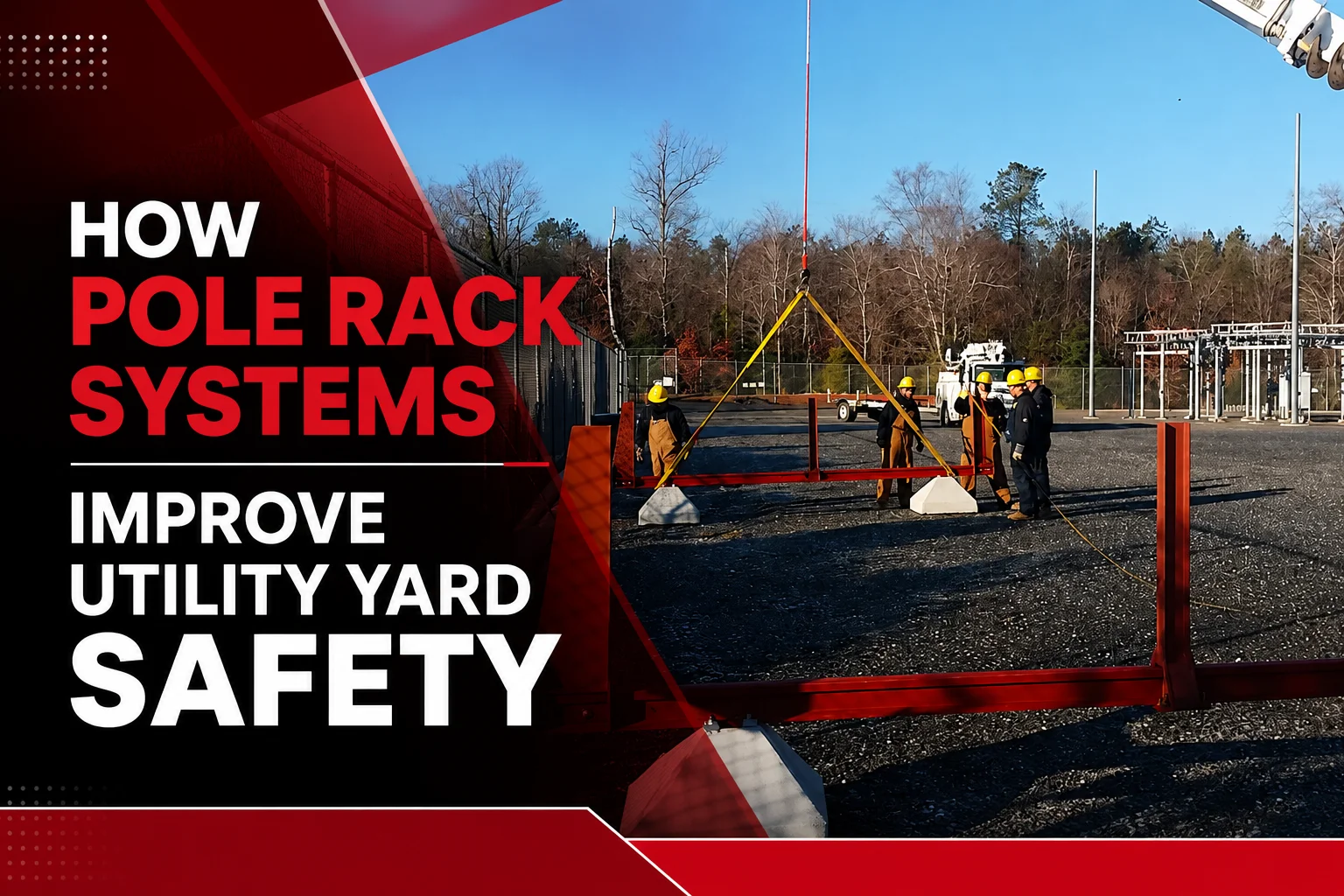
Rack storage eliminates both failure modes. Poles on a properly engineered rack system are elevated off the ground, supported at appropriate intervals to prevent deflection, accessible for visual inspection without unstacking, and positioned for clean loading onto transport vehicles. The inventory that goes in comes out in the same condition. When replacement lead times are measured in months, that is a meaningful reduction in operational risk.
What This Means for Pole Yard Planning
Utilities reviewing their pole yard infrastructure should be thinking about storage capacity not just as a function of today’s inventory levels but as a strategic buffer against a market where restocking is slow and unpredictable. A yard sized around just-in-time delivery assumptions – built when lead times were weeks, not months – is undersized for the environment utilities are actually operating in now.
Inventory sizing, yard layout, rack configuration, and the ground conditions under which poles are stored all factor into that calculation. The utility that expands storage capacity during a period of supply stability is in a fundamentally different position when the next shortage develops than the one that deferred that investment.
CMS Utility Services designs pole yard infrastructure around actual operational requirements, not standard templates. The design process – provided at no cost to utility clients – starts with understanding inventory volumes, storm exposure, supply chain assumptions, and the specific site conditions that determine what a functional, compliant yard looks like for that utility. The output is a yard that protects the inventory it holds and functions under the conditions the utility actually faces, including the ones that have changed in the past several years.
The pole shortage will ease. What it has made visible is structural and will not disappear when lead times normalize. Utilities that use this period to bring their storage infrastructure to the level the operating environment demands will be better positioned for the next disruption, whatever its cause.
| Talk to CMS About Pole Yard Design and Storage Infrastructure
CMS Utility Services provides free pole yard design consultations for utility companies across the United States and Canada. If your current yard was not designed around today’s supply environment, storm exposure, or regulatory requirements, a conversation with our team is the right starting point. ☎ Call us: Kentucky: (502) 362-9797 | Florida: (941) 743-7889 → Visit: Pole Yard Design and Construction — cmsus.com/design-and-construction/ |