Utility poles are built to last decades. That durability doesn’t come from the wood, it comes from the chemical treatments applied to protect against rot, insects, and moisture. Pentachlorophenol, creosote, and chromated copper arsenate have been the industry standard for generations. They work. But they also leach and when they do, the contamination doesn’t stay in the yard.
Groundwater contamination from pole treatment chemicals is one of the more persistent and underreported environmental liabilities in utility operations. The chemicals involved are potent, the migration pathways are slow and hard to detect, and the regulatory exposure for utilities that haven’t been addressed is growing. Here’s what’s actually happening below the surface and what responsible operators are doing about it.
What’s in the Wood, and Where It Goes
The three primary wood preservatives used in utility poles each carry distinct contamination risks.
Pentachlorophenol (PCP) is a chlorinated compound with a long half-life in soil and water. It’s classified as a probable human carcinogen and is highly toxic to aquatic organisms. Once it enters the soil column, it binds to organic matter but continues migrating toward the water table over time.
Creosote is a coal tar derivative containing hundreds of individual compounds, many of them polycyclic aromatic hydrocarbons (PAHs). PAHs are persistent, bioaccumulative, and carcinogenic. Creosote doesn’t dissolve easily in water, but it does migrate – slowly and in ways that are difficult to reverse once contamination is established.
Chromated Copper Arsenate (CCA) introduces arsenic directly into the soil. Inorganic arsenic is a known human carcinogen with no safe exposure threshold. CCA-treated poles have been largely phased out of utility use, but legacy inventory in older yards continues to represent an active contamination source.
When treated poles are stored in an unprotected yard – directly on soil, without containment – rain and surface runoff do the rest. Chemicals leach from the ends and surfaces of poles, accumulate in the soil beneath storage areas, and eventually reach the water table. Depending on soil permeability, geology, and rainfall patterns, that process can unfold over months or years before detection.
The Regulatory Pressure Is Increasing
The EPA has regulated pole yard runoff under RCRA (Resource Conservation and Recovery Act) and Clean Water Act frameworks for years, but enforcement attention has intensified. Utilities operating pole yards without adequate containment and stormwater management are increasingly exposed to compliance actions, remediation orders, and third-party liability if contamination migrates off-site.
State environmental agencies have added their own layers. In many jurisdictions, pole yards now require documented stormwater pollution prevention plans (SWPPPs), regular monitoring, and evidence of containment infrastructure. The cost of non-compliance – remediation, fines, legal exposure – consistently exceeds the cost of building a compliant yard in the first place.
What’s changed in recent years is not the underlying science. It’s the enforcement environment and the availability of practical containment solutions that make compliance achievable without rebuilding a yard from scratch. How Contamination Spreads Through a Yard The migration pathway is predictable, even if the timeline varies. Treated poles off-gas and leach continuously, especially in warm weather and when exposed to precipitation. Stormwater picks up surface contamination and either infiltrates directly into the soil or runs off the yard, carrying chemicals into adjacent drainage systems, retention areas, or natural water bodies.
High-contact points in the yard, end-grain exposure on cut poles, areas where poles are loaded and unloaded, any location where mechanical damage has compromised the outer wood surface – are the primary source zones. Without a liner, berm, or drainage management system capturing that runoff, every rain event is a contamination event. Soil saturation over time creates a concentrated plume beneath and around storage areas. Once that plume reaches fractured rock or a permeable aquifer layer, horizontal migration accelerates. Neighboring properties, municipal water supply wells, and sensitive ecological areas can all be affected, often without any visible surface indication that contamination is occurring.
What Containment Actually Looks Like
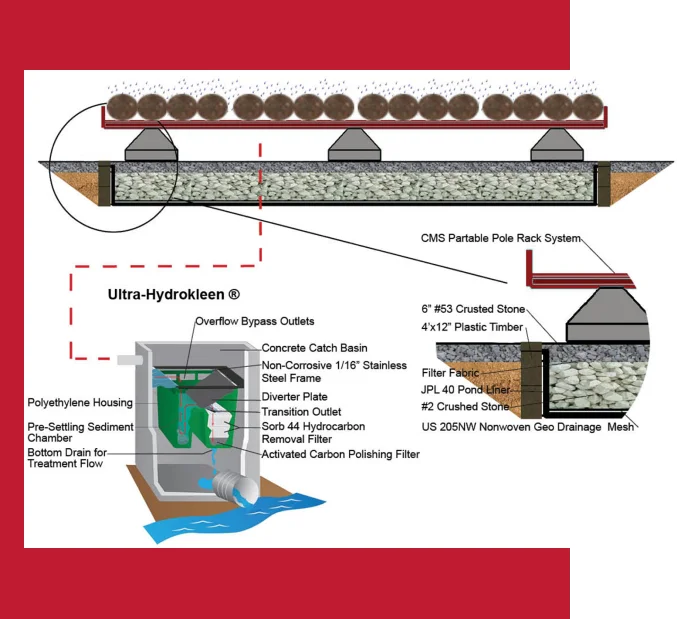
Effective containment isn’t one system; it’s a layered approach that starts with the ground and works upward. CMS’s approach to EPA-compliant containment and filtration begins with impermeable liner systems that prevent direct soil contact, paired with perimeter berms and graded drainage that direct all runoff to a collection point.
From there, filtration matters. Captured stormwater that has contacted treated poles carries dissolved and suspended contaminants that can’t simply be discharged. Properly designed filtration systems remove PCP, PAHs, and heavy metals to levels that meet discharge standards, or allow for safe on-site retention and evaporation depending on the yard’s location and regulatory requirements.
The design of these systems is site-specific. Soil type, annual precipitation, yard size, inventory volume, and local discharge regulations all influence what a compliant system looks like in practice. There is no universal template, which is why chemical runoff management systems need to be engineered around actual site conditions rather than installed off-the-shelf.
What Utilities Can Do Right Now The first step is an honest assessment of current exposure. Utilities operating pole yards on unlined soil, without documented stormwater management, are carrying both environmental and regulatory risk that compounds over time.
Engagement with a team that understands both the EPA requirements and the operational realities of a working utility yard is the fastest path to a defensible compliance position. CMS specializes in treated pole yard stormwater solutions that meet regulatory standards without disrupting day-to-day operations, from initial site evaluation through system installation and documentation.
Groundwater contamination from pole treatment chemicals is preventable. The question for most utilities isn’t whether to act, but how quickly they can close the gap between current conditions and what the regulatory environment is moving toward.