When Hurricane Harvey tore through Texas in 2017, it brought down more than 5,000 utility poles and left over 250,000 customers without power. The utilities that restored service fastest were not the ones with the most poles on hand. They were the ones with the most organized yards, where crews could walk in, identify what they needed by type and spec, and stage without burning hours on improvised sorting. The difference between a 48-hour restoration and a week-long outage is often traced back to a decision made long before the storm arrived, about what kind of storage infrastructure was actually worth the investment.
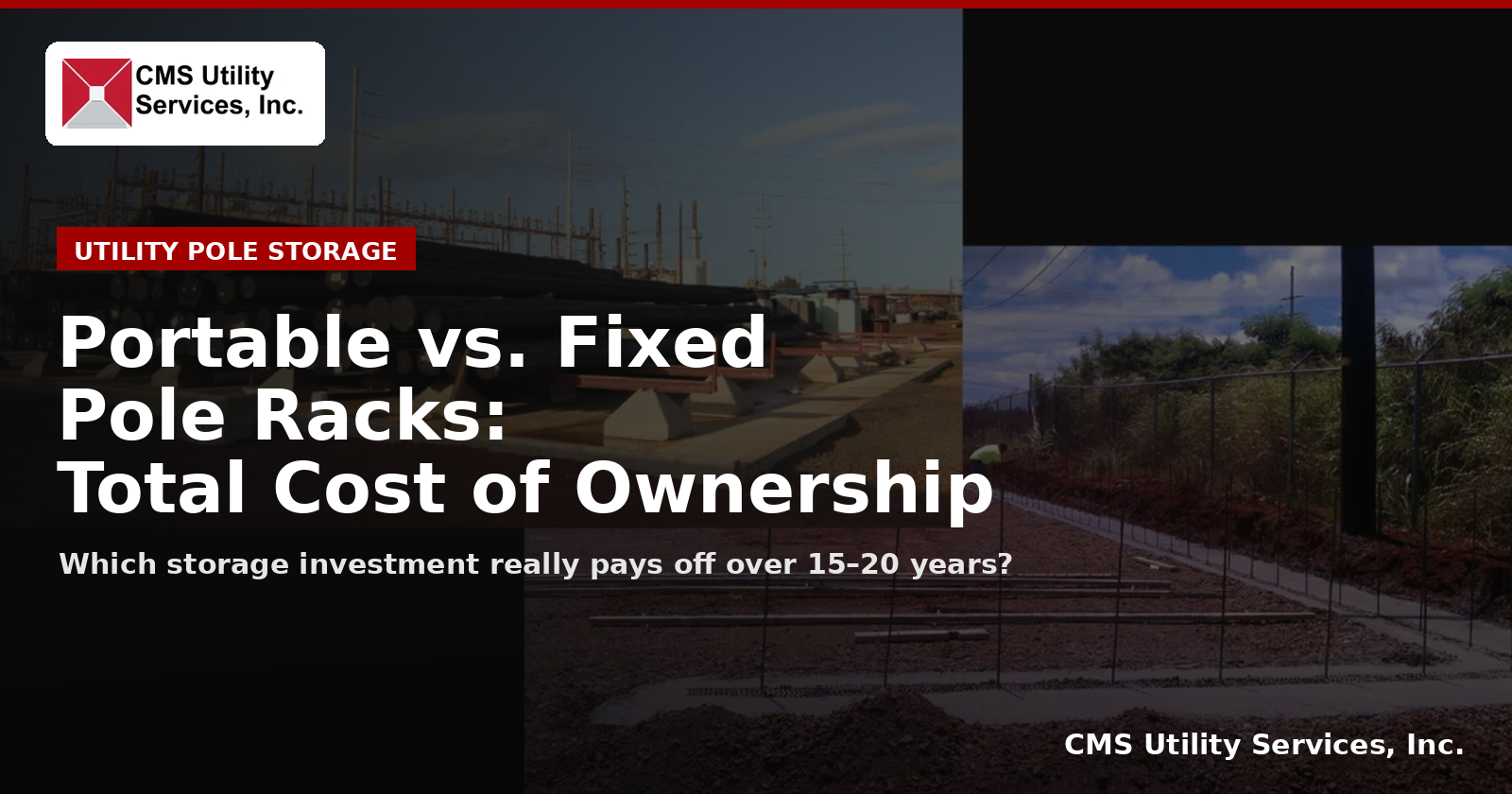
Many conversations about pole rack systems start with the price tag. How much does it cost upfront? Which system fits this year’s budget? Those are fair places to start, but they stop well short of the question that actually matters. Which option costs less to own over the full life of the asset? That shift in thinking from purchase price to total ownership cost is where the portable vs fixed pole racks total cost of ownership comparison gets genuinely interesting.
Portable Pole Racks: The Full Financial Picture
The appeal of portable systems is straightforward. They move when you need them to, whether that means deploying to a storm staging yard, setting up at a temporary worksite, or repositioning as operations change. For utilities managing multiple service areas or building emergency response capacity, that flexibility has real operational value.
The upfront economics are appealing too. Lower purchase prices, minimum site preparation, and simpler initial setup make portable racks easier to budget and faster to put into service. When storage demands are seasonal or the volume stays modest, they often make perfect financial sense.
Where the math starts working against you is in the wear that comes with regular field use. Repeated loading, transport, and redeployment put stress on every bracket, weld, and connector that a fixed system never experiences. Add freight costs, crew hours, and fuel across multiple cycles per year, and the affordable option starts carrying a heavier long-term price than the original quote implied.
Staying ahead of that deterioration is where pole rack refurbishment services earn their place in the budget. Catching corrosion and weakened components early keeps repair costs predictable and prevents the kind of structural failure that pulls equipment out of service at the worst possible time. Operators who schedule refurbishment consistently get years more useful life from their portable systems.
Fixed Pole Racks: Where You Get Long-Term Value
Fixed systems carry a higher entry cost, and there is no softening that fact. The purchase price is larger, and the site requirements are more involved, but what those costs buy is durability and load capacity that portable systems cannot consistently match when storage demands are high and continuous.
The labor savings tend to make a compelling case over time. Crews working from a well-organized fixed yard do not spend time hunting for poles, sorting under pressure, or working around equipment that was not staged correctly. Every pole is where it should be, every time. During an emergency response, that predictability directly translates into faster dispatch and fewer costly errors.
There is also less damage to the inventory itself. Poles that stay in a stable, engineered environment do not take the same beating as poles that move through portable configurations repeatedly, and for concrete or steel poles with high per-unit cost, that protection is crucial.
A fixed system performs just like the yard around it. Congested lanes, poor drainage, and no pole segregation logic will undermine the efficiency advantages of even the most well-built racks. This is why professional pole yard design & construction is as important as the racks themselves. A thoughtfully planned yard ensures that your solid fixed rack investment pays back consistently for decades.
Breaking Down TCO: Five Categories That Tell the Actual Story
When comparing portable vs fixed pole racks, these five categories reveal the reality of the actual cost.
Acquisition and Setup Costs
Portable systems are ahead on this front. Lower purchase prices and a simpler initial utility pole rack installation process mean less capital tied up at the start, which makes a real difference for operations keeping a close eye on their budgets.
Ongoing Transportation and Redeployment Costs
This is where the portable advantage starts to disappear. Freight, fuel, crew time, and equipment handling for every move become a recurring expense that builds across seasons and never really flattens out.
Maintenance and Refurbishment Costs
Fixed systems are easier to plan around because their maintenance schedules are predictable. Portable systems get pushed harder in the field, and the repair demands that follow are harder to anticipate, making long-term cost planning a trickier exercise.
Labor Efficiency Over Time
A fixed system in a well-run yard speeds up staging and crew operations day in, day out. Over years of use, those hours accumulate and often close more of the upfront cost gap than most people expect.
Compliance and Environmental Management Costs
Both system types come with stormwater and treated pole storage obligations. Fixed infrastructure with built-in containment generally makes staying compliant a more straightforward, less expensive part of running the yard.
Which Option Suits Your Operation?
Portable racks are a financially sound choice for utilities with variable storage needs, limited permanent yard space, or multi-site response requirements. They also work well alongside fixed infrastructure, adding surge capacity during heavy storm activations without requiring permanent expansion.
Fixed systems make more sense when pole inventory is consistent, volume is high, and the yard will see heavy year-round use. Explore our full range of portable and fixed pole racks to compare specs and options. The total cost picture over 15 to 20 years usually tells a very different story than the upfront pricing does.
A hybrid approach works well for many operations. Fixed racks anchoring the primary yard, portable systems taking care of field deployment, and seasonal overflow. That combination captures the strengths of both without locking you into the limitations of either.
The Decision That Pays Off After Installation
Every utility operation has a right answer to the portable vs fixed pole racks total cost of ownership question, and it comes from looking honestly at storage volume, deployment patterns, and how much operational friction your current setup is quietly costing you every season.
CMS Utility Services has worked through this decision alongside utility companies for over four decades. Whether the next step is a new pole rack installation, a yard built from ground zero with expert pole yard design and construction, or bringing aging infrastructure back to standard through pole rack refurbishment, the experience is there to help you land on a storage strategy that retains its value well into the future.
Frequently Asked Questions
How long do portable pole racks typically last compared to fixed systems?
Fixed pole racks remain operational for 20 to 30 years in good conditions. Portable systems, given the strain of repeated transport and redeployment, generally perform reliably for 10 to 15 years, though that range shortens meaningfully without consistent inspection and upkeep.
At what point does a fixed system become more cost-effective than portable racks?
For most operations, the total cost crossover happens somewhere between five and eight years, once transportation, labor, and maintenance costs for portable systems are fully accounted for. High-volume operations tend to reach that point sooner.
Does pole yard design really affect rack system ROI that much?
More than most people expect. A fixed rack system in a poorly designed yard can give back most of its efficiency advantages within the first year of operation. Getting the lane layout, drainage, and pole segregation right from the start protects the long-term value of the entire investment.