When a major storm tears through a service area, the clock starts the moment the wind dies down. Utility companies face thousands of customers without power, downed lines blocking critical roads, hospitals running on backup generators, and pressure from regulators, local officials, and the public to restore service as fast as possible. In that environment, every hour of delay translates directly into lost revenue, public safety risk, and damage to your company’s reputation.
One of the most decisive factors separating utility companies that recover quickly from those that struggle for days is how fast replacement poles reach the field. That depends almost entirely on a piece of infrastructure most people never think about until they need it: the emergency pole rack. More specifically, it depends on whether that rack is ready to receive poles the moment it arrives on site — or whether crews are still waiting for it to be built.
What Emergency Pole Rack Deployment Actually Is
Emergency pole rack deployment is the rapid positioning of pole storage systems at staging locations close to a disaster zone, so field crews can pull replacement utility poles without long supply runs from a central warehouse. The rack system holds the inventory. The staging location closes the distance between the poles and the repair site. That combination is what compresses the restoration timeline.
In normal operations, pole racks sit at fixed locations — a utility company’s main yard or a regional service center. When a major storm hits, those locations are often hours away from the actual damage zone. Moving the rack closer to the work eliminates the logistical bottleneck that turns a two-day recovery into a five-day one.
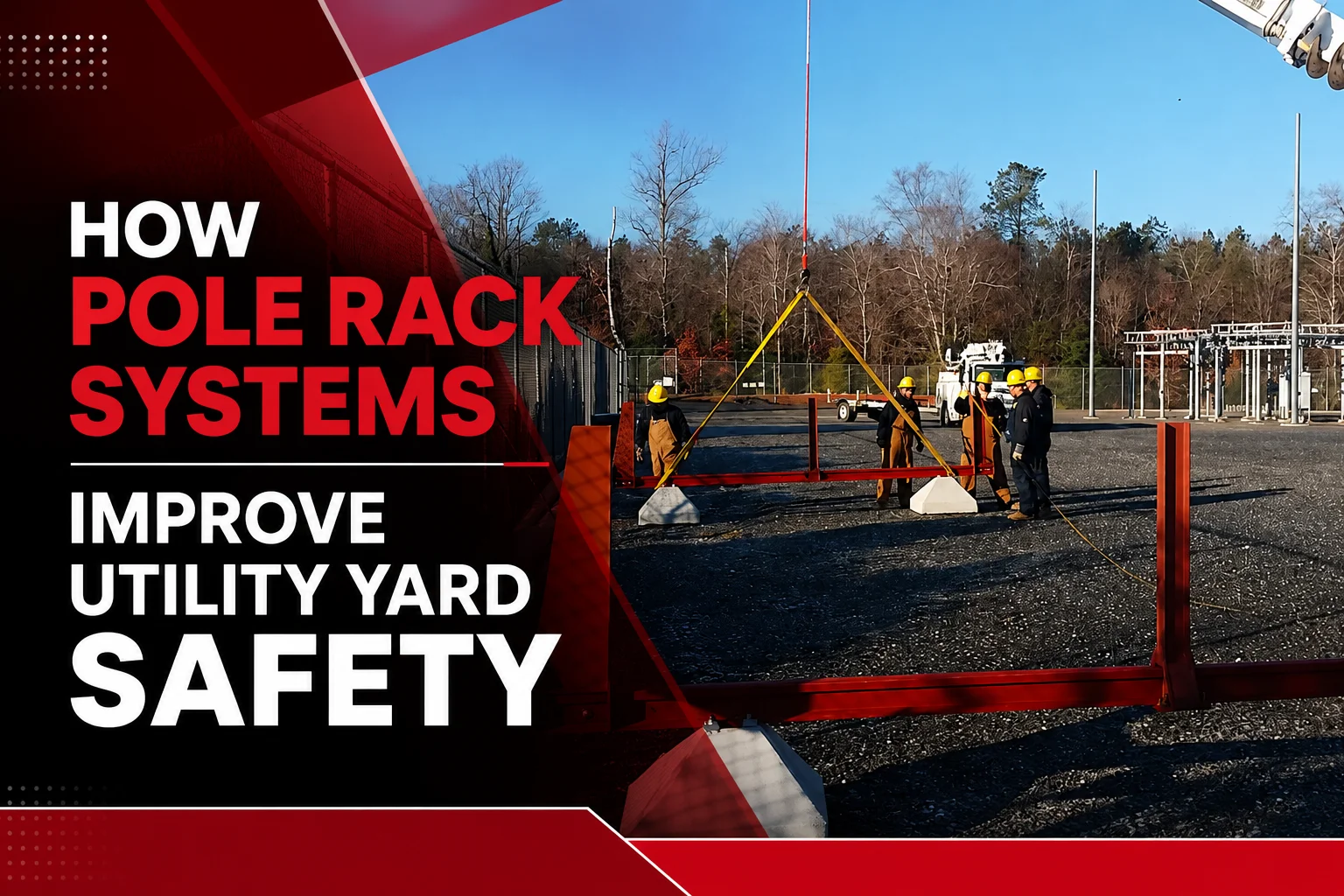
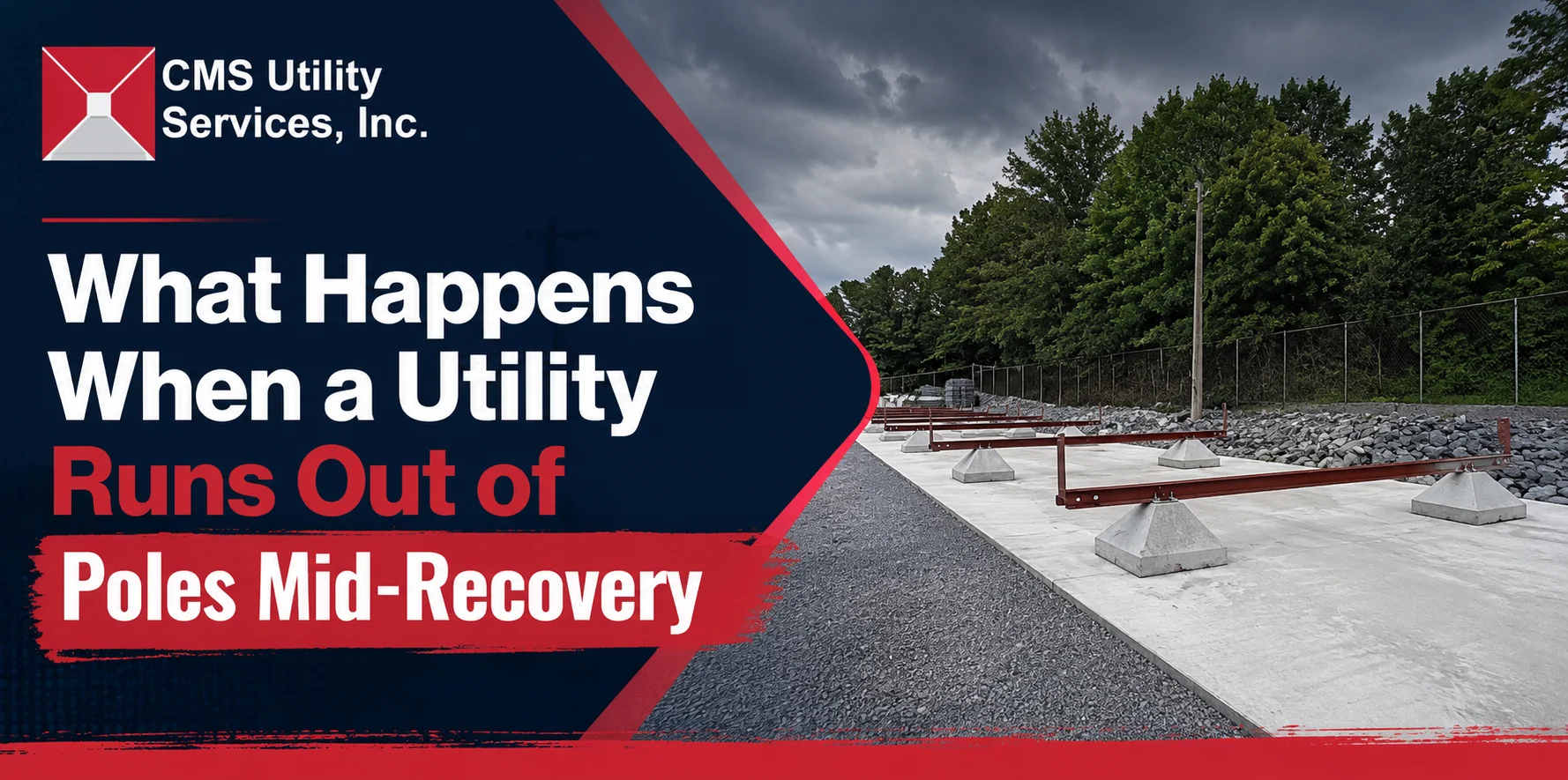
The critical variable is what happens when the rack arrives. CMS pole rack systems are delivered fully pre-configured. There is no on-site assembly. No components to fit together. No time lost before the first pole goes on the rack. The unit arrives complete, gets positioned at the staging location, and is immediately ready to receive inventory. Utility crews load it, dispatch from it, and replenish it. CMS can also handle transport and on-site positioning directly for utilities that prefer a fully managed deployment. Either way, the rack is operational from the moment it reaches the site.
Why Deployment Speed Matters More Than Most Utilities Account For
Public safety risk compounds by the hour. Live downed lines, dark traffic signals, failed pump stations, and customers dependent on home medical equipment all create real-world hazards that grow more serious the longer power stays out. State public utility commissions in storm-prone regions have tightened restoration reporting requirements significantly after every major event, and regulators in Florida, Texas, Louisiana, North Carolina, and across the Gulf Coast have made it clear that restoration timelines are being tracked and compared.
The U.S. Department of Energy has consistently documented that weather-related power outages cost the American economy tens of billions of dollars annually. That figure reflects direct economic disruption, but it doesn’t capture the reputational exposure that comes from real-time outage maps, social media coverage, and customers who can see exactly how long their utility is taking to restore service compared to neighboring companies. Faster recovery is no longer an advantage — it’s the expectation.
When deployment stalls because poles are staged 100 miles away, or because crews are waiting on equipment that isn’t ready to receive poles the moment it arrives, those hours translate directly into extended outages. The pole rack is not the bottleneck anyone wants to discover mid-recovery.
What Preparation Looks Like Before the Storm Arrives
The most reliable predictor of how fast a utility company recovers after a storm is what it did before the storm arrived. The logistics of emergency deployment cannot be improvised under pressure.
High-performing utility operations teams pre-position rack systems at regional locations identified as storm-vulnerable before the season begins. Because CMS racks ship pre-configured, there is no lead time required once a unit reaches its pre-staged location. When the storm clears and damage assessment begins, dispatch is the only action required — not assembly, not waiting for components.
Inventory inspection is a non-negotiable part of pre-season preparation. Rack systems that have sat through multiple seasons without a formal check accumulate the kind of wear — corrosion, damaged contact points, compromised structural components — that only becomes visible when someone looks for it. CMS offers pole rack refurbishment for units that need reinforcement, repair, or protective recoating before the next deployment cycle. Refurbishment consistently delivers more useful life per dollar than replacement and keeps emergency inventory at the readiness level the job requires.
Logistics coordination matters as much as the physical equipment. Which trucks are designated for pole rack transport. Who authorizes dispatch. What the communication chain looks like at 2 a.m. during an active recovery. Right-of-way agreements and pre-authorization paperwork with municipal and state emergency operations contacts should be current before storm season, not drafted during the emergency. Crews that lose hours to access delays or authorization backlogs during an active event are paying for the absence of planning that could have been done in the preceding months.
For utilities that may be overwhelmed by a major event, pre-negotiated surge agreements with CMS allow additional pre-configured rack systems and experienced crews to be dispatched on short notice. That kind of capacity agreement — negotiated in advance, not scrambled for after the storm hits — is one of the structural differences between a 48-hour recovery and a 96-hour one.
How Deployment Actually Runs
Once the storm passes and damage assessment begins, deployment runs in parallel with line damage mapping — not after it. Pre-positioned racks are already in the region. Additional units are loaded and dispatched immediately, moving with the first wave of assessment crews so that by the time replacement poles are needed, the rack is already positioned and ready.
Staging site selection determines how efficiently the rack functions once it’s there. Flat, accessible ground with truck maneuvering room is the baseline requirement. Paved or compacted gravel is preferable to soft or wet soil, which can shift under load and create safety risks. The staging location should be close enough to the repair sites that round-trip drive time stays minimal, and far enough outside the damage zone that access isn’t restricted by downed lines or debris.
Once the rack is on site and positioned, crews load poles immediately. Weight distribution across the rack needs to be even, within rated capacity, and secured against rolling before any poles are pulled for the field. Crane and forklift clearance around the rack needs to be maintained throughout the operation. Lineman safety doesn’t become optional under the pressure of emergency response — a loading incident sets the entire recovery back further than a careful approach ever would.
A staging area coordinator tracking inventory against what’s being dispatched to repair sites keeps the operation from running dry at the wrong moment. Replenishment from secondary yards should be moving before the staging rack is fully depleted, not after. Simple inventory tracking — a whiteboard, a tablet-based check-in, anything consistent — keeps that picture accurate during peak activity when fatigue and speed work against it.
When recovery is complete, the rack loads back onto a truck. It goes back to its pre-staged location, or moves to support recovery in a neighboring service area. After-action documentation — what worked, what slowed things down, what changes next time — is the most consistently undervalued part of storm response and the easiest to skip when crews are exhausted. It is also the primary input for the preparation that determines how the next event unfolds.
What Slows Utilities Down
The same bottlenecks appear repeatedly across regions and storm types. Staging ground that is soft, wet, or uneven — identified during the emergency rather than before the season — costs hours to work around and creates rack stability issues that didn’t have to happen. Rack systems that haven’t been inspected in several years arrive with corrosion, missing hardware, and damaged contact points that turn a straightforward positioning into an extended problem.
Logistics coordination gaps are the most common source of delay that has nothing to do with the rack itself. If the designated transport truck is committed elsewhere, if dispatch authorization requires a contact who’s unreachable, or if access to a staging site requires a permit that wasn’t pre-arranged, the rack sits idle while the repair crew waits. None of those delays happen on equipment that fails. They happen in planning that wasn’t done.
Field communications break down when cell networks are damaged, which is exactly when they’re most needed. Satellite communications or two-way radios at every staging area aren’t redundant preparation — they’re the baseline for maintaining command visibility when the primary network is compromised.
What to Look for in an Emergency-Grade Pole Rack System
Not every pole rack is built for emergency conditions. The design characteristics that matter in a permanent yard setting are different from what determines performance in an emergency deployment. A rack that requires on-site assembly adds construction time at the exact moment when time is the resource in shortest supply. Pre-configured delivery — ready to position and immediately operational — is the baseline for any system intended for emergency use.
Load capacity needs to be documented and tested, not estimated. A utility pulling replacement poles under pressure cannot afford to discover a rack’s limits through failure in the field. Corrosion resistance matters wherever racks are staged outdoors or in coastal environments, with galvanized or coated steel and documented ratings for extended exposure. Stable ground contact — wide base plates, adjustable feet, anchor options — reduces time spent on site preparation and prevents shifting under load over the course of a multi-day deployment.
Compatibility with the range of pole sizes a utility actually stocks is a practical requirement that gets overlooked in procurement. An emergency rack that handles only one pole class is a liability when the storm damage requires a mix. CMS rack systems are configurable across pole lengths and classes, with rated load capacities documented for each configuration.
CMS Utility Services has manufactured and deployed pole rack systems built to these specifications for more than four decades, with utility clients across the United States depending on the same pre-configured design for both permanent yard operations and emergency response.
Regional Considerations
Emergency pole rack deployment looks different depending on where the storm happens. Gulf Coast utilities — Texas, Louisiana, Mississippi, Alabama, Florida — operate in a hurricane season that runs June through November, with peak activity in August and September. Racks pre-positioned inland protect against storm surge, and surge agreements with vendors outside the impacted region are essential when a major storm overwhelms local inventory within the first 48 hours.
In the Southeast, a combination of hurricanes, tropical storms, and severe thunderstorm activity creates a long active season. Inland flooding frequently closes major routes, making multiple staging locations across a service area essential to maintain coverage when primary roads are inaccessible.
The Midwest and Plains face tornadoes, derechos, and ice storms. Ice storm damage in particular can affect thousands of poles across hundreds of square miles simultaneously, requiring large-scale deployment in a compressed window that can outstrip even well-stocked yards within 48 hours. The Northeast adds sub-freezing staging conditions to that challenge — cold-rated equipment, heated crew environments, and ground heaters at staging surfaces are operational requirements, not options.
The Pacific Northwest deals with wind storms and ice events across mountainous terrain that limits staging options. Narrow access corridors and uneven ground are the baseline, not the exception, and coastal salt air creates ongoing corrosion exposure that makes rack material ratings a real selection criterion. In California and the West, Public Safety Power Shutoffs and wildfire-related infrastructure damage have added planned deployment cycles alongside storm response, with higher pole volumes cycled through staging racks over longer planned windows.
CMS Utility Services has deployed pole rack systems across all of these regions. Visit the CMS services page for a full overview of deployment support, pole yard design, EPA-compliant containment, and installation services.
How CMS Utility Services Supports Emergency Deployment
CMS Utility Services has built its service model around the operational realities of post-storm response. The pre-configured pole rack systems arrive complete — no assembly, no wait. Utility crews load them onto a truck and deploy, or CMS delivers and positions them directly. The result is a staging system that is operational from the moment it arrives on site.
Core capabilities include pre-configured modular pole racks ready for immediate deployment; over 40 years of experience across every U.S. climate and storm profile; rapid response with experienced crews available on short notice during active events; pole rack refurbishment to extend service life ahead of storm season; pole yard design and construction for permanent storage facilities; and EPA-compliant containment and filtration for environmentally sensitive staging and storage areas. CMS serves utility companies nationwide.
Frequently Asked Questions
Do utility crews need to assemble CMS pole racks on site?
No. CMS pole racks are delivered fully pre-configured. There is no on-site assembly. Crews position the rack at the staging location and begin loading poles immediately. CMS can also handle transport and on-site positioning directly.
How long does emergency pole rack deployment take?
Because the racks arrive pre-configured, deployment time is primarily a function of transport distance from the pre-staged location to the staging site. There is no assembly time. For pre-positioned units already close to the damage zone, racks can be operational within hours of dispatch.
Can emergency pole racks move between storm-damaged locations?
Yes. CMS emergency rack systems load onto a truck and redeploy to a new staging site as the recovery effort moves through a service area or shifts to a neighboring region. That portability is a core design requirement, not an afterthought.
What is the difference between an emergency pole rack and a permanent yard rack?
Permanent pole yard racks are fixed installations designed for long-term storage at a central facility. Emergency racks are portable systems designed for rapid field deployment. Both are engineered for safe pole storage, but emergency racks are built around mobility and immediate readiness rather than a permanent foundation.
How many poles can an emergency rack hold?
Capacity varies by configuration. CMS builds systems that scale to field requirements, with rated load capacities documented for each configuration. Large-scale events often use multiple racks staged in series at the same location.
Can existing pole racks be refurbished instead of replaced?
Yes. CMS pole rack refurbishment includes structural inspection, repair, reinforcement, and protective recoating. For racks that are structurally sound but showing wear, refurbishment extends service life at a fraction of replacement cost and keeps emergency inventory at the readiness level storm response requires.
What regions does CMS Utility Services cover for emergency deployment?
CMS supports utility companies across the United States, with experience deploying pole rack systems in hurricane regions along the Gulf and East Coasts, tornado-prone areas in the Plains, ice storm zones in the Midwest and Northeast, and wildfire-affected service territories in the West.
Be Ready Before the Next Storm
Storms don’t wait for utility companies to be ready. The difference between a utility that restores power in 48 hours and one that takes five days isn’t the storm — it’s the preparation. Pre-positioned racks. Pre-negotiated surge agreements. Logistics coordination done in the calm season, not during the emergency.
CMS pole rack systems arrive pre-configured and ready to use. No assembly on site. No wait time before the first pole loads. The rack works from the moment it gets there.
To discuss emergency pole rack deployment options for your service area, contact CMS Utility Services for a consultation and a free quote.