Pole racks are the backbone of any utility yard operation. They keep your utility pole inventory organized, accessible, and safely elevated – day in, day out, in all weather conditions. But like any piece of heavy-duty infrastructure, pole racks degrade over time. The problem is that deterioration rarely announces itself with a dramatic failure. Instead, it builds slowly through small, easy-to-miss warning signs that – left unaddressed – can lead to structural collapse, worker injuries, damaged pole inventory, and costly operational downtime.
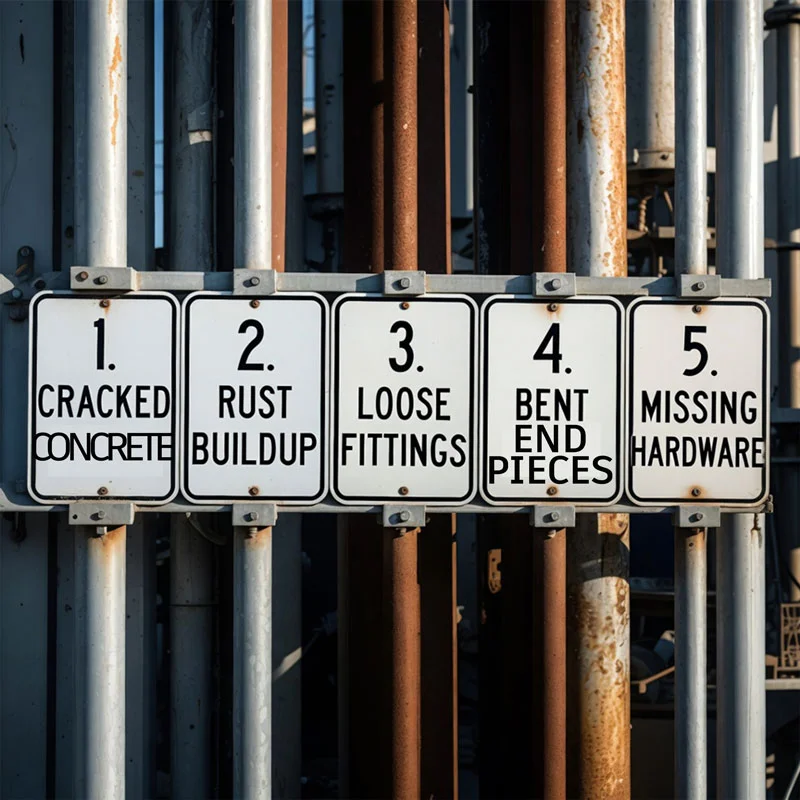
Knowing what to look for is the difference between a proactive pole rack refurbishment that costs a fraction of a replacement and an emergency situation that shuts down your entire pole yard. Here are the five warning signs every utility operations manager should know.
Warning Sign #1: Visible Rust, Corrosion, or Surface Deterioration
Steel pole rack components are exposed to the elements year-round – rain, humidity, road salt, and chemical runoff from treated wood poles all accelerate corrosion. Surface rust might appear minor at first glance, but it rarely stays surface-level for long.
When iron oxide begins eating into the structural steel of a rack’s uprights, crossmembers, or base plates, the load-bearing capacity of the entire system is quietly compromised. A rack that looks mostly intact on visual inspection may already be operating at a fraction of its rated capacity underneath a layer of rust.
Watch for these specific corrosion indicators during your yard inspections:
- Orange or brown staining streaking down vertical support members
- Pitting or flaking on horizontal crossbars and connection points
- Rust weeping from bolt holes, weld seams, or bracket interfaces
- White or chalky oxidation on galvanized or coated components
If corrosion has progressed beyond the surface coating into the base metal, a professional refurbishment assessment is no longer optional – it is urgent.
Warning Sign #2: Bent, Warped, or Deformed Structural Members
Utility poles are heavy. A single wood distribution pole can weigh several hundred pounds, and concrete transmission poles can weigh several tons. Over years of loading and unloading cycles, even well-designed rack systems experience cumulative stress on their structural members.
Bent uprights, bowed crossmembers, and warped support arms are not cosmetic issues – they are indicators that the rack has absorbed more stress than it was designed to handle and may be approaching a failure threshold. In many cases, deformation is localized to high-load zones that are easy to overlook during routine walk-throughs.
Key deformation signs to inspect for include:
- Uprights that are no longer plumb (visibly leaning or bowing outward under load)
- Horizontal crossmembers with a visible sag or curve when viewed along their length
- Support arms that have shifted angle from their original welded or bolted position
- Connection hardware – bolts, pins, or brackets – that have sheared, cracked, or stretched
Any deformation visible to the naked eye is grounds for an immediate pole rack refurbishment evaluation. Do not wait for the next scheduled inspection cycle.
Warning Sign #3: Unstable, Cracked, or Sunken Foundation Bases
A pole rack is only as strong as the foundation it sits on. Concrete base pads, anchor bolts, and ground-level footings are subjected to ground movement, freeze-thaw cycles, water infiltration, and heavy vehicle traffic in busy utility yards. Over time, this punishment manifests in ways that directly undermine rack stability.
This is one of the most dangerous warning signs because a compromised base can cause an entire rack bay to tip or shift without warning – especially during emergency pole rack deployment operations when loading and unloading speed is prioritized over caution.
Foundation warning signs to check:
- Hairline or visible cracks running through concrete base pads
- Sections of the base pad that have heaved, sunken, or separated
- Anchor bolts that are loose, corroded, or pulling away from the concrete
- Rack base plates that rock or shift when moderate lateral pressure is applied
- Pooling water around base pads indicating drainage failure underneath the footing
Warning Sign #4: Damaged, Missing, or Deteriorated Pole Bunks
Pole bunks – the individual cradle components that directly contact and support each utility pole – are the most load-stressed elements in any rack system. They absorb weight, vibration from yard traffic, and the abrasive contact of wood, steel, and concrete poles being loaded and unloaded by equipment operators.
Damaged bunks are one of the leading causes of pole damage in utility storage yards. A split, cracked, or missing bunk allows poles to roll, shift, or drop, creating both inventory damage and a serious safety hazard for workers in the yard.
- Cracked or split wood bunk material that no longer provides even pole support
- Rubber or composite bunk pads that have hardened, torn, or compressed flat
- Missing bunks that leave poles resting directly on steel support arms
- Bunk mounting hardware that has loosened, allowing the bunk to shift under load
Bunk replacement is one of the most cost-effective elements of a comprehensive pole rack refurbishment service – and one of the highest-impact repairs for both safety and pole inventory protection.
Warning Sign #5: Faded, Peeling, or Absent Protective Coating
The protective paint or galvanized coating on your pole racks is not just cosmetic – it is the primary barrier between your structural steel and the corrosive environment of an outdoor utility yard. Once that barrier is compromised, moisture infiltration accelerates dramatically, and the timeline to structural deterioration shortens significantly.
A rack whose coating is fading, chalking, peeling, or showing bare metal patches is telling you clearly that its corrosion protection has failed. Without intervention, you will be dealing with Warning Sign #1 within one to two seasons.
- Paint that is fading, chalking, or bubbling on any structural surface
- Bare metal spots where coating has fully peeled or been scraped away by equipment
- Galvanized surfaces showing white rust or black spotting indicating zinc layer failure
- Previously repainted sections that are already failing, indicating adhesion problems
Professional recoating as part of a refurbishment service dramatically extends rack service life – often at less than 20% of the cost of full system replacement.
When You See the Signs, Act Before You Pay the Price
Any one of these five warning signs warrants a professional assessment. When two or more are present simultaneously, the case for immediate pole rack refurbishment is urgent. Deferred maintenance on pole rack systems does not save money – it converts a manageable repair cost into an emergency replacement expense, and in the worst cases, into a worker safety incident.
At CMS Utility Services, our refurbishment process begins with a thorough structural inspection, followed by a customized repair plan covering bunk replacement, structural reinforcement, base repair, and protective recoating. We also pair refurbishment with complementary services including pole rack installation for new rack sections, pole yard design and construction to optimize your storage layout, and EPA containment and filtration for yards storing treated wood poles.
Do not wait for a rack to fail. Contact CMS Utility Services today for a free refurbishment consultation and give your pole racks the second life they need to keep your operations safe, organized, and ready for whatever storm season brings.